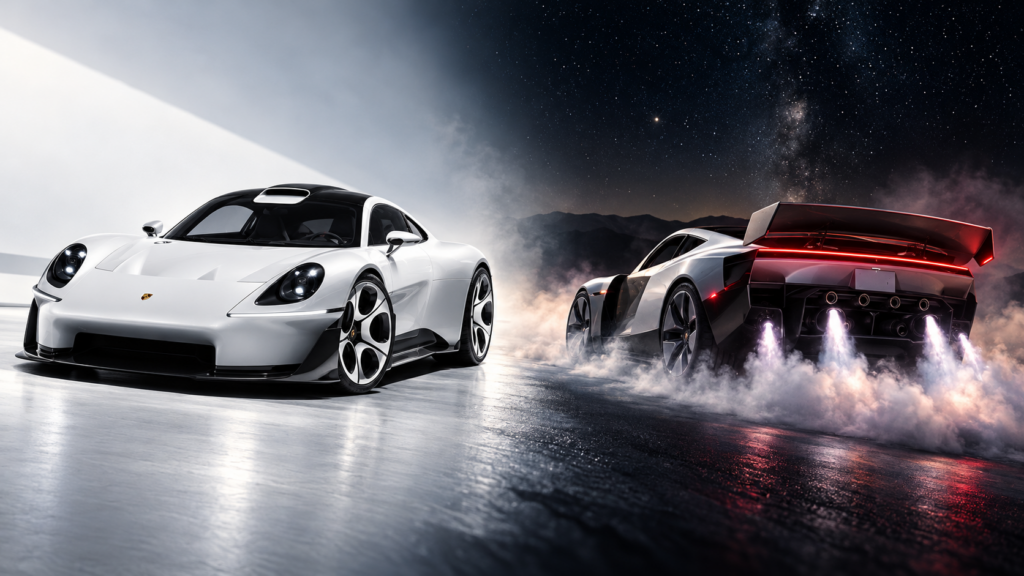

There are days when the internet seems to make up its mind before breakfast. Today was one of those days. Within a few hours of each other, Porsche and Tesla presented two very different ideas of what an ultimate sports car should be. Porsche unveiled the Mission S in New York, a wonderfully low, unapologetically dramatic mid-engined concept that previews a new model line above the 911. Tesla, meanwhile, went to a SpaceX facility in Texas and showed a Roadster driving upside down, accelerating to 60 mph in 0.81 seconds and, because apparently accelerating in less than a second is no longer sufficient for the internet, actually leaving the ground.
You can probably guess which one won social media.
Within hours, Porsche’s announcement was being mocked. Memes appeared showing Teslas jumping over Porsches, people were declaring that Tesla had stolen Porsche’s show, and the Mission S was portrayed as evidence that an old German carmaker had turned up to a rocket launch with a beautifully polished combustion engine. And visually, I understand it completely. What Tesla showed was magnificent. I mean that without irony. Watching something that looks broadly like a road car drive up an inverted structure, hang upside down, detach itself, rotate through the air and land again is one of those wonderfully stupid moments of engineering where your inner twelve-year-old temporarily takes control of your brain. Then Tesla sent another prototype over a row of its own vehicles using compressed-air thrusters. If this had happened in a James Bond movie, I would probably have complained that the special-effects department had gone a little too far. Instead, engineers from Tesla and SpaceX actually built it.
That deserves respect. Quite a lot of it, actually. But there is an important distinction between something being technically extraordinary and something being a meaningful innovation in a production car. And that distinction seems to have been lost somewhere in the smoke cloud.
First, can we please stop calling everything innovation?
The Tesla Roadster demonstration was an engineering achievement. It was also, in large part, a stunt. Those two things are not mutually exclusive, and I don’t think we need to diminish the engineering talent involved to question the usefulness of the result. Tesla says the most extreme Roadster uses ten cold-gas thrusters supplied by two pressure vessels holding a combined 600 litres and approximately 250 kilograms of compressed air. Four rear thrusters produce more than 80 kilonewtons of thrust, with the exhaust leaving faster than the speed of sound. There is also an underbody fan system capable, according to Tesla, of generating sufficient suction to hold the car upside down.
Those numbers are genuinely bonkers. Eighty kilonewtons is roughly equivalent to the gravitational force acting on eight metric tonnes. That does not mean the car suddenly weighs eight tonnes when the thrusters fire, obviously, but it gives some sense of the forces Tesla is playing with. And it explains why I struggle when this is discussed as though Porsche has simply been technologically embarrassed. Because what exactly is the product innovation here?
Being able to propel a vehicle into the air for a few seconds is undoubtedly impressive. Being able to do that safely in an IKEA car park on Saturday afternoon, surrounded by pedestrians, shopping trolleys, loose stones, drain covers, bicycles, other vehicles and one person who has somehow decided that the fire lane is an excellent place to load a wardrobe into a Golf is an entirely different engineering problem. The same applies to those extraordinary acceleration figures. A car that can accelerate to 100 km/h in the time it takes most people to blink twice is fascinating, but on a public road, where other road users do not necessarily share your enthusiasm for experimental propulsion systems, there is a point where the performance becomes increasingly academic.
Interestingly, Tesla seems to recognise this itself. The Roadster is being separated into different configurations. The Performance version is the road-focused two-seater, equipped with a suction system for additional downforce. Thrust adds rear-mounted cold-gas thrusters for extreme acceleration. The one-seat Rocket version gets the full ten-thruster arrangement and is described as “air ready” rather than road ready. It is invite-only and, according to Tesla’s own information, not approved for normal public-road use.
That is quite an important detail. The car that broke the internet is not really the car most Roadster buyers will drive to dinner. And that brings us to something even more interesting than the spectacular footage itself: what happens when we apply a little physics to the claims?
Then there is the slightly inconvenient matter of physics
Elon Musk said during the presentation that the Roadster can refill its compressed-air system itself, so owners would not need some kind of SpaceX compressor installed next to their Tesla Wall Connector. Technically, there is nothing impossible about that statement. An electric compressor can absolutely take atmospheric air and pump it into high-pressure storage tanks. The interesting question is not whether it can be done. The interesting question is how much energy and time it takes, where that energy comes from, and how much additional machinery you need to carry around to make it happen.
Tesla gave us enough information to make a useful back-of-the-envelope calculation. According to the presentation, the Rocket Roadster carries approximately 250 kilograms of compressed air in pressure vessels with a combined volume of 600 litres. Using an ideal-gas approximation at roughly room temperature puts the storage pressure in the neighbourhood of 360 bar, or a little over 5,000 psi. At such pressures, real air no longer behaves exactly like an ideal gas, so the precise pressure may differ. Nevertheless, it gives us a useful starting point for understanding the scale of the system.
Now let’s compress 250 kilograms of atmospheric air to around 360 bar. Even with theoretically perfect isothermal compression, the thermodynamic minimum is approximately 35 kWh:
W = mRT × ln(P₂/P₁)
Using 250 kg of air, an air gas constant of approximately 287 J/kgK, a temperature of 300 K and a pressure ratio of 360 gives roughly 127 megajoules, equivalent to 35 kWh. And that is the absolute theoretical minimum under our assumptions. It requires compression with perfect heat management and no mechanical or electrical losses. In other words, a compressor designed by somebody who has apparently negotiated an exemption from the second law of thermodynamics.
Real compressors are considerably less accommodating. For illustration, a compression system operating at 50 to 70 percent of that theoretical ideal would consume approximately 50 to 70 kWh of electrical energy for a complete refill. That is a scenario based on assumed efficiency, not a measured figure for Tesla’s equipment. The actual energy requirement would depend on compressor design, compression stages, cooling, operating temperature and storage pressure. Tesla has not published sufficient technical information to calculate it precisely, but the example illustrates how quickly the energy requirements become substantial.
And this creates another interesting problem. Tesla has not disclosed the new Roadster’s battery capacity. The company has emphasised lightweight construction and extraordinary acceleration, two objectives that generally discourage carrying around more battery mass than necessary. A battery capacity of 100 kWh or less is therefore a reasonable scenario to examine, although it would be speculation to suggest that Tesla has actually selected such a capacity. If the Roadster had a 100 kWh battery, replenishing the compressed-air supply could consume 50 to 70 percent of its nominal capacity under our illustrative assumptions. With an 80 kWh battery, that would become 62.5 to 87.5 percent. And that is before driving the car, powering the suction fans or accounting for the fact that not all of a battery’s nominal capacity is normally accessible to its owner.
At 11 kW, even the theoretical minimum of 35 kWh would take more than three hours to replenish. Our illustrative 50 to 70 kWh would require approximately four and a half to six and a half hours at that power level, assuming continuous operation and ignoring further charging losses. Of course, Tesla could engineer a much more powerful compressor. It could also refill the tanks while connected to an external electricity supply rather than drawing all that energy from the vehicle’s battery. But then we have to account for the additional weight, cooling requirements, electrical load and physical space required by that compressor. Those are not insurmountable engineering challenges, but they are engineering compromises. And compromises tend to become rather important when you are trying to build one of the lightest and fastest accelerating production cars in the world.
That is before we even discuss what happens when the stored air leaves the car.
Tesla says its four rear-facing thrusters produce more than 80 kilonewtons of thrust, roughly equivalent to the gravitational force acting on 8.2 metric tonnes. For a car. Eighty kilonewtons is not a decorative puff of air from a particularly enthusiastic leaf blower. It is an enormous amount of force delivered through high-speed gas jets, which Tesla says reach supersonic exhaust velocities. Unlike the exhaust of a conventional car, this system is specifically designed to accelerate substantial quantities of gas in the opposite direction to generate thrust. And that exhaust has to go somewhere.
If somebody were standing directly behind an operating thruster, the consequences could be catastrophic. High-speed gas jets can cause severe injuries through direct impact and accelerated debris, and an unprotected pedestrian sufficiently close to such a system could potentially suffer fatal injuries. How far that danger extends depends on the nozzle geometry, jet expansion, pressure, duration and distance. We cannot simply declare that everybody standing thirty metres behind the car would be killed, because Tesla has not provided the technical information necessary to calculate a safe exclusion zone. But a system designed to generate 80,000 newtons of thrust raises a rather obvious question for anybody responsible for vehicle safety: What happens to the cyclist, pedestrian, motorcyclist or unfortunate Volkswagen Polo immediately behind it?
And the thrusters are only half the problem. The Roadster also uses a powerful underbody suction system intended to generate additional downforce by extracting air from underneath the vehicle. According to Tesla, it can produce enough suction to hold the car upside down. That is remarkable engineering, but ordinary roads are not laboratory floors. They contain loose gravel, stones, broken glass, leaves, drainage grates, service covers and occasionally road surfaces that are not quite as structurally sound as the authorities would like us to believe.
A sufficiently powerful suction system operating close to the ground can pick up loose debris and potentially disturb inadequately secured road fixtures. Whether it could actually lift a particular manhole cover depends on the pressure differential, exposed area and how securely that cover is retained. A properly secured manhole cover is not automatically going to fly into the air just because an extremely expensive Tesla drives over it. But the underlying problem is real. And if debris enters the suction system, it must either be captured, tolerated safely or prevented from being expelled somewhere dangerous.
The McMurtry Spéirling, another extraordinary electric hypercar using fan-generated downforce, is a good example of engineers taking this problem seriously. Its designers use filters and carefully engineered fan systems to manage airflow and prevent debris from passing through the system. That is precisely the sort of engineering work that rarely makes for spectacular launch footage but becomes critically important when technology moves from a controlled demonstration into something customers are expected to operate.
Imagine activating that enormous suction system while driving over loose gravel, a damaged drainage grate or a poorly secured inspection cover. Suddenly, the question isn’t how much additional cornering grip the car can generate. It is whether the road surface and everything attached to it can safely cope with the forces involved. The risks posed by the suction fans and the thrusters are different, but both require substantial engineering safeguards. And both raise important questions about public-road approval.
There are very good reasons why vehicle homologation involves far more than proving that something can accelerate, corner or fly. A production vehicle must also meet safety requirements for its occupants, other road users and pedestrians. Would a car equipped with unrestricted rear-facing cold-gas thrusters and an extremely powerful road-facing suction system receive ordinary approval across Europe, the United States and other major automotive markets? I would be extremely sceptical. That does not establish that every possible version would be illegal everywhere. Operating restrictions, safeguards and national regulations matter. But Tesla’s own distinction between its road-focused Performance version and its invite-only Rocket version is telling. The unrestricted flying capabilities shown today are not approved for normal road use.
Which brings us back to the actual duration of the spectacle. Thrust is fundamentally related to mass flow and exhaust velocity. If the four rear thrusters produce 80 kN and the exhaust velocity is somewhere between 500 and 700 metres per second, producing that force would require approximately 110 to 160 kilograms of air every second. With 250 kilograms stored onboard, that suggests somewhere around 1.5 to 2.2 seconds at full stated thrust, even if the entire stored supply could be used by those four nozzles. Real performance depends on changing tank pressure, nozzle efficiency, temperature and how the system distributes its air. Those are estimates, not Tesla specifications, but the order of magnitude matters.
We are talking about seconds, not minutes.
Enough for an extraordinary launch, an astonishing acceleration run or a short jump that makes millions of people stare at their screens in disbelief. Not enough to turn a road car into a practical aircraft. And once the show is over, you have a complicated collection of high-pressure tanks to refill, potentially tens of kilowatt-hours of electricity to supply, substantial mechanical and thermal challenges to manage, and a vehicle whose most impressive features may never be legally usable on public roads.
None of this means that Tesla’s engineers have achieved nothing. Quite the opposite. What they demonstrated is remarkable, and I would genuinely love to see the technical documentation behind it. But it illustrates why the distinction between an engineering demonstration and a production-ready innovation matters. Tesla has demonstrated that it can make a car fly for a few seconds. It has not demonstrated that making a car fly is useful, practical, safe or commercially sensible for its intended owners.
And perhaps that is the most Tesla thing about this entire presentation. The marketing department showed us the future. The engineering department still owes us a few answers about how we are supposed to live in it.
The Roadster is real. The promise is the thing I question.
There is another reason I am reluctant to compare what Tesla showed directly with what Porsche presented. The Tesla Roadster has been coming for nearly nine years. Tesla originally unveiled the second-generation Roadster in November 2017 and said deliveries would begin in 2020. That date came and went. So did several later targets. The new production target is now 2028. If Tesla hits it, eleven years will have passed between the original unveiling and production.
Maybe it will happen this time. I actually hope it does. But after almost a decade, “look what our prototype can do” should reasonably be judged differently from “here is the production car you can buy next year.” And to be fair, Porsche has not unveiled a production-ready Mission S either. What Porsche showed today is a vision model, and the final vehicle could look and perform differently. The difference is that Porsche is presenting the design direction and engineering philosophy for a new permanent model line, while Tesla is demonstrating spectacular capabilities that it already acknowledges will not be available for unrestricted public-road use.
And that is why I am deliberately not dragging Starship, Optimus, Full Self-Driving or every other Musk promise into this argument. It would be tempting, but it would also weaken the point. SpaceX has achieved very real engineering milestones, and Tesla has changed the automotive industry in ways that are difficult to overstate. The Roadster’s own history gives us more than enough evidence that Musk’s timelines should be treated as ambitions until cars are coming off a production line.
The funny thing is that Musk himself acknowledges the Roadster is not particularly important financially. It has been described as a halo product rather than a major contributor to Tesla’s revenue. Which brings me to the part I find particularly interesting: the stock market still pays enormous attention to these demonstrations.
Tesla was valued at approximately $1.43 trillion at the close of trading on October 15, and reports indicated a positive share-price reaction following the Roadster presentation. That does not prove Tesla is overvalued. Valuation is ultimately an argument about future cash flows, and investors are obviously not valuing Tesla merely as a manufacturer of Model Ys. They are pricing in expectations around autonomous driving, robotaxis, energy, AI, robotics and technologies that may or may not generate the returns currently anticipated. Whether those expectations are reasonable is a completely separate article.
But it helps explain why spectacular demonstrations matter so much to Tesla. They reinforce a narrative of extraordinary future capabilities, even when the commercial product remains years away or the most impressive features cannot realistically be used on public roads. Tesla does not merely sell products. It sells a story about what comes next.
Today, that story had Mach diamonds.
Porsche, meanwhile, did something almost embarrassingly old-fashioned
Porsche unveiled a sports car. Well, technically it unveiled a vision model for a sports car, which is an important distinction. The Mission S previews a new mid-engined platform positioned above the 911. Porsche says this will not simply be another limited 918 Spyder-style project that appears for a couple of years before disappearing into climate-controlled collections. The intention is to create a permanent model line at the top of the Porsche range, combining the company’s heritage with a new design direction.
And I think it looks absolutely beautiful.
There are references to the 550 Spyder, 959, 911 GT1, 917 and 928 without the car looking like somebody simply fed Porsche’s museum catalogue into an AI image generator. The proportions are wonderful, the low bodywork is immediately recognisable as Porsche, and the interior feels refreshingly focused on the driver rather than on impressing somebody from the consumer-electronics industry. There are physical controls, no permanently integrated central television dominating the dashboard, and a reimagined analogue-inspired Sport Chrono element. Porsche has somehow managed to make the absence of an enormous touchscreen feel rebellious in 2026, which is an achievement I did not know we needed.
The engine is expected to be a combustion-based powertrain, potentially with hybrid assistance, rather than a purely electric system. Porsche has not yet confirmed the final production specifications, so there is still plenty we don’t know. But the decision to focus on combustion rather than a fully electric hypercar does disappoint me a little. I own an electric car, and I remain convinced that for the overwhelming majority of everyday vehicles, electric propulsion is simply the better technology. It is dramatically more energy-efficient, produces no exhaust emissions while driving, is quiet, mechanically simpler in important respects and extremely pleasant to use.
But I also think we need to stop pretending that every automotive segment exists for the same reason. Nobody buys a €500,000-plus supercar because the total cost of ownership spreadsheet came out favourably. And treating a top-tier enthusiast car as though its fundamental purpose were to provide the most efficient transportation from A to B misunderstands why people buy these machines in the first place.
A Rolex is a terrible Apple Watch
A modern Apple Watch is, in almost every functional sense, a vastly more capable device than a Rolex. It tells the time, measures your heart rate, tracks exercise, shows messages, makes payments, navigates, detects falls and can call emergency services. A Rolex mostly tells you what time it is, sometimes not even as accurately. And yet nobody walks into a Rolex dealer, slams an Apple Watch Ultra onto the counter and triumphantly announces that Switzerland has lost.
Because that completely misunderstands the product.
A mechanical watch is bought for craftsmanship, history, design, scarcity, emotion, status and the strange satisfaction humans get from owning beautifully engineered objects that perform a task in a gloriously unnecessary way. The very inefficiency is part of the point. A top-level supercar increasingly occupies a similar position. At €500,000, €800,000 or €1 million, fuel economy is not a purchase criterion. Neither, increasingly, is acceleration from 0 to 100 km/h. Electric power has made brutal acceleration almost mundane, and that change becomes particularly obvious when you compare the cars we drive today with the supercars we dreamed about a few decades ago.
Take my own Tesla Model Y Performance, for example. It is a perfectly practical family SUV. We use it for everyday driving, shopping and the sort of journeys nobody would ever describe as particularly glamorous. Yet its acceleration from 0 to 100 km/h is in roughly the same territory as that of an original Lamborghini Diablo, depending on the particular versions compared. The early Diablo managed the sprint in approximately four and a half seconds, an extraordinary achievement at the time. My Tesla Model Y Performance does the sprint in about 3.5 seconds.
And that is genuinely remarkable to me, because the Lamborghini Diablo was one of the cars of my childhood. I had posters of it on my walls and model versions of it that I admired for hours. It represented the absolute pinnacle of automotive performance, an almost unreachable piece of engineering that looked as though it had arrived from another planet. Its outrageous shape, enormous V12 engine and performance figures were the stuff of dreams. And now, a few decades later, a family SUV sitting in my driveway can accelerate in roughly the same time while carrying shopping bags, luggage and the family.
Does that mean I would rather have my Model Y than a Lamborghini Diablo if somebody offered me the keys to both for a sunny Sunday afternoon?
Of course not.
And that is exactly the point.
At the very top of the automotive market, buying decisions are about experience, rarity, craftsmanship, sound, design, history and the prospect of owning something that will remain desirable twenty or thirty years from now. Some buyers may also see such cars as investments, although future appreciation is never guaranteed. In that world, a combustion engine can make sense for exactly the same reason a mechanical movement makes sense in an expensive watch. Not because it is the most efficient way to perform the task, but because efficiency is not the primary reason for owning it.
And that is why I can appreciate Porsche’s decision to build the Mission S around a combustion-based powertrain. I would personally have loved to see an electric version as well, but I understand the thinking. The top end of the supercar market is not necessarily where electrification provides its greatest benefits, either commercially or environmentally. A handful of extraordinarily expensive combustion-engined sports cars makes very little difference to global emissions compared with what happens in the mass market.
However, that argument only works if Porsche remembers that most of the vehicles it sells are not million-euro collector’s items.
Where I do disagree with Porsche
Porsche’s new “Sportwagenschmiede ’35” strategy explicitly talks about “Value over Volume”, greater exclusivity, more individualisation and an increased focus on higher-margin vehicles. The company wants to become more profitable and less dependent on enormous production volumes, targeting a break-even point below 200,000 vehicles annually. Considering that Porsche delivered 279,449 cars in 2025, that represents a meaningful strategic shift.
I understand the commercial logic. Porsche has faced difficult market conditions, especially in China, and the company needs to protect its profitability. Selling fewer cars at higher margins can be an entirely reasonable business strategy. But I am less convinced by the temptation to turn Porsche into some approximation of Ferrari, because Porsche is not Ferrari. And the numbers make that distinction rather difficult to ignore.
Ferrari shipped 13,640 cars in 2025. Lamborghini delivered 10,747. Together, those two manufacturers accounted for approximately 24,400 vehicles. Porsche, meanwhile, delivered 51,583 examples of the 911 alone. That means Porsche sold more than twice as many 911s as Ferrari and Lamborghini sold cars combined. Its total deliveries of almost 280,000 vehicles were more than twenty times Ferrari’s annual shipments.
That scale is not an unfortunate side effect of Porsche’s business model. It is part of what Porsche is. This is the company that can build an almost absurd 911 GT3 RS and also sell tens of thousands of Cayennes and Macans. In fact, those two SUV lines alone accounted for more than 165,000 Porsche deliveries in 2025. Porsche operates on an entirely different scale from Ferrari, and trying to manufacture the same level of scarcity across the brand risks misunderstanding one of its greatest strengths.
Porsche’s success has come partly from making extraordinary engineering and an extraordinary brand accessible to a considerably broader customer base than traditional exotic-car manufacturers. A Macan is not a Ferrari, nor should it try to be one. It is a Porsche that serves a different purpose, and it helps fund the engineering capabilities that make the spectacular sports cars possible in the first place.
Fortunately, Porsche’s actual strategy is more nuanced than some headlines suggest. The company has not abandoned electric vehicles. The electric Macan already exists, the Cayenne Electric is part of the product range, and Porsche says that the coming 718 Boxster and Cayman models will be fully electric, with their first full production year expected in 2028. The 911 also already has hybrid assistance in the form of its T-Hybrid powertrain. Porsche continues to pursue a combination of electric, plug-in hybrid and combustion propulsion.
My concern is not that Porsche has suddenly decided electricity was a mistake. It has not. My concern is the direction of travel. The company has reduced the pace of its earlier electrification ambitions, extended the life of combustion-based platforms and shifted investment toward products it expects to generate higher margins. In 2025, 22.2 percent of Porsche deliveries were fully electric, while 34.4 percent were electrified when plug-in hybrids were included. Those numbers show that electric Porsche models have an established market, even if demand has developed differently from earlier expectations.
For the Mission S, I am perfectly comfortable with a combustion engine. For high-volume SUVs and everyday cars, however, I want Porsche to keep pushing much harder. If Porsche eventually produces a few hundred or a few thousand Mission S vehicles annually, their collective exhaust emissions will be tiny compared with those of hundreds of thousands of daily-driven SUVs and sedans. That is where electrification makes a meaningful difference. That is where efficiency matters at scale, where energy consumption adds up over hundreds of thousands of kilometres, and where technological progress can produce substantial environmental benefits.
I would love a future where somebody can take a classic 911 or a combustion-engined Mission S out on a sunny Sunday afternoon without feeling that enjoying a beautiful mechanical object somehow contradicts their environmental responsibilities. Sustainable synthetic fuels might eventually play a role in preserving those cars, although they remain expensive, energy-intensive to produce and dependent on how the electricity and carbon used to manufacture them are sourced. That is a perfectly reasonable area for innovation. But it should not become an excuse to delay electrification where it actually delivers the greatest benefits.
We can preserve mechanical watches without demanding that everybody throw away their smartphones. And we can celebrate the combustion engine as a wonderful piece of automotive history without insisting it remain the default powertrain for the family SUV.
So did Tesla steal Porsche’s show?
Yes. Completely.
If we define “the show” as social-media attention during a 24-hour period, Porsche never stood a chance. One company unveiled a beautifully shaped sports car with an analogue-inspired cockpit and a traditional driving philosophy. The other company made a car perform aerial manoeuvres using technology developed with a rocket company. From a pure entertainment perspective, the result was inevitable.
But did Tesla therefore demonstrate that it is more innovative than Porsche? I do not think that follows at all. Innovation is not simply the ability to do something nobody has done before. It is also the ability to turn technology into something useful, repeatable, manufacturable, safe and valuable to the people who will actually use it. And some of the most impressive engineering achievements are the ones we barely notice because they work reliably every single day.
The McMurtry Spéirling had already demonstrated fan-generated downforce before Tesla, including the ability to generate enormous grip independently of vehicle speed. Tesla’s combination of suction, cold-gas propulsion and vehicle control takes these ideas somewhere wonderfully extreme, but extremity and utility are not synonyms. The Rocket Roadster may become an astonishing engineering toy that a very small number of wealthy people can own and operate under controlled conditions. I sincerely hope it does. I would love to see one in person, although I would very much prefer somebody else to demonstrate the flying capabilities while I stand a sensible distance away.
But I am not going to pretend that ten compressed-air thrusters make a vehicle inherently more advanced as a road car than a Porsche simply because the Porsche remains stubbornly attached to the ground. Sometimes engineering excellence is visible as smoke, noise and a car flying over a Cybertruck. Sometimes it is a beautifully shaped piece of machinery that can be homologated, manufactured, serviced, driven for hundreds of thousands of kilometres and still feel desirable twenty years later. Both can be impressive. They are simply solving completely different problems.
And perhaps the funniest part of this entire comparison is that both companies are doing exactly what their brands have always done. Elon Musk built something that makes half the internet shout, “That cannot possibly be real.” Porsche built something that makes people quietly start calculating what organs they could live without.
I am not sure either company could have produced a more on-brand product launch if it tried.