

I have read quite a few leadership books over the years. Some were useful in the moment and then quietly disappeared from memory. Others stayed with me because an idea from a chapter would suddenly reappear months later in a conversation with someone on my team, during a difficult decision, or when I caught myself stepping in to solve a problem that probably should not have become mine in the first place. Those are the books I value most. Not because I agree with every page, but because they changed something in the way I actually lead.
I am generally sceptical of leadership models that promise a universal formula. People respond differently, teams have different levels of experience and maturity, and the situation around them matters. An approach that works well in a growing, established team may be exactly the wrong one in a turnaround or with a newly formed group. Still, a few ideas have become increasingly important to me over time: building an environment where people can speak openly, treating the relationship between employer and employee honestly, giving people real ownership instead of just tasks, and being prepared to change my own approach when the situation changes. The four books below have influenced how I think about those things more than most.
Leaders Eat Last: Leadership starts with the environment you create
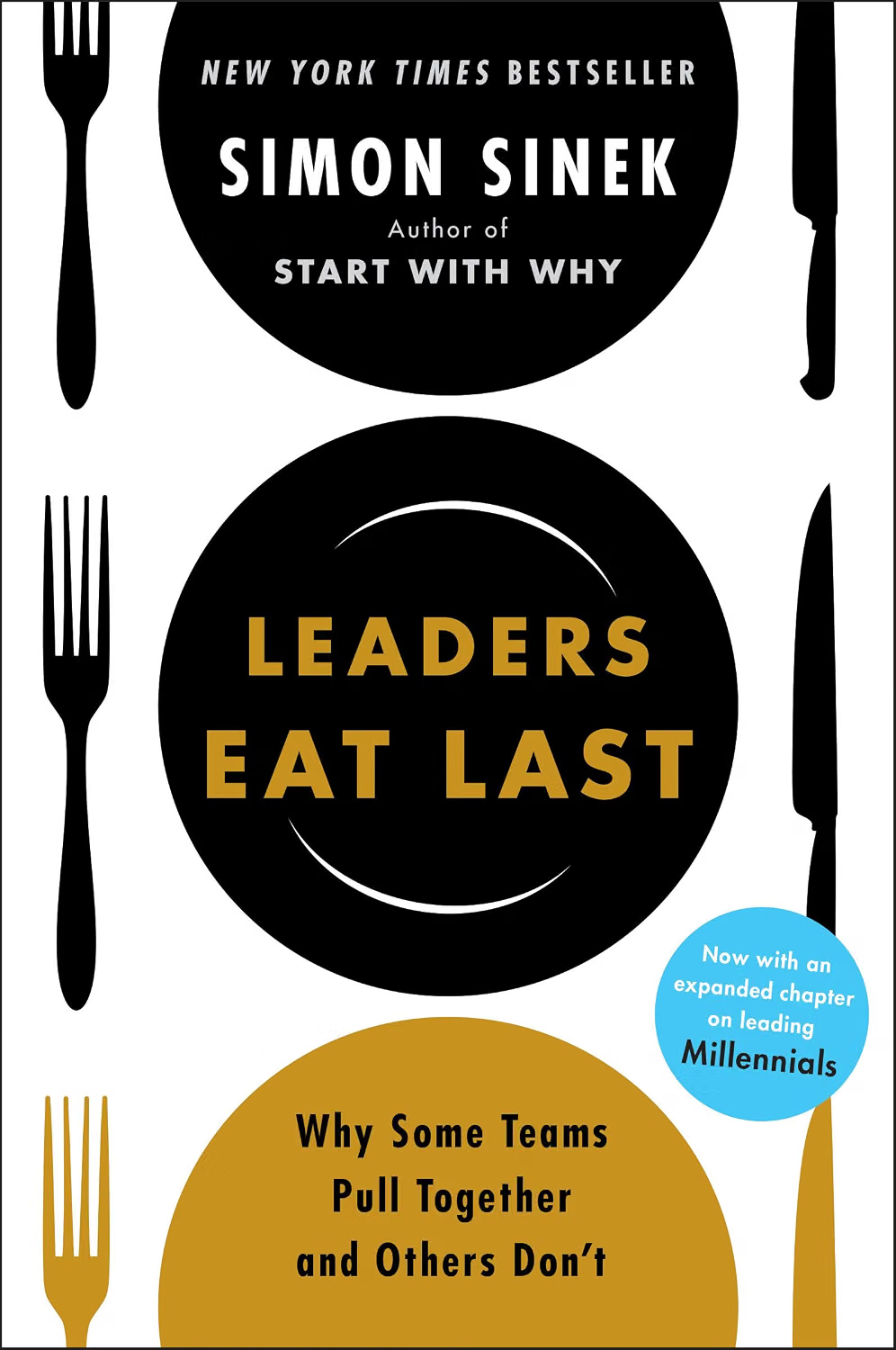
Image by Amazon.de
Simon Sinek’s Leaders Eat Last is built around the idea that leaders are responsible for creating an environment in which people feel safe enough to trust one another and work together. Sinek describes this as a “Circle of Safety”: people should not have to spend unnecessary energy protecting themselves from colleagues or internal politics when that energy could be spent solving problems for customers, the business or each other.
What stayed with me is less the terminology than the change in perspective behind it. If the starting question is simply how to get more performance from a team, it is easy to focus on targets, processes and individual output. If the question becomes what kind of environment allows people to perform well, you start looking at your own behaviour as a leader much more critically. A team in which mistakes are hidden because people fear the reaction will behave very differently from one where someone can say early that something is going wrong. The same is true when people expect their manager to take credit for successes but distance themselves from failures. In that kind of environment, self-protection becomes rational behaviour.
For me, psychological safety does not mean lowering expectations or removing accountability. People should be able to disagree, challenge my assumptions, say that they do not know something and occasionally make the wrong decision without fearing that one mistake will define them. At the same time, commitments still matter, and people need to take responsibility when something does not work. The useful part of Sinek’s idea is that trust is not something a manager can simply announce. It develops through small, repeated interactions: how you react when somebody brings bad news, whether you listen when someone disagrees with you, whether you give credit fairly, whether you keep your own commitments and whether you stand behind the team when things become uncomfortable. You can create the conditions for trust, but the people around you decide whether you have actually earned it.
The Alliance: Stop pretending employment is a family
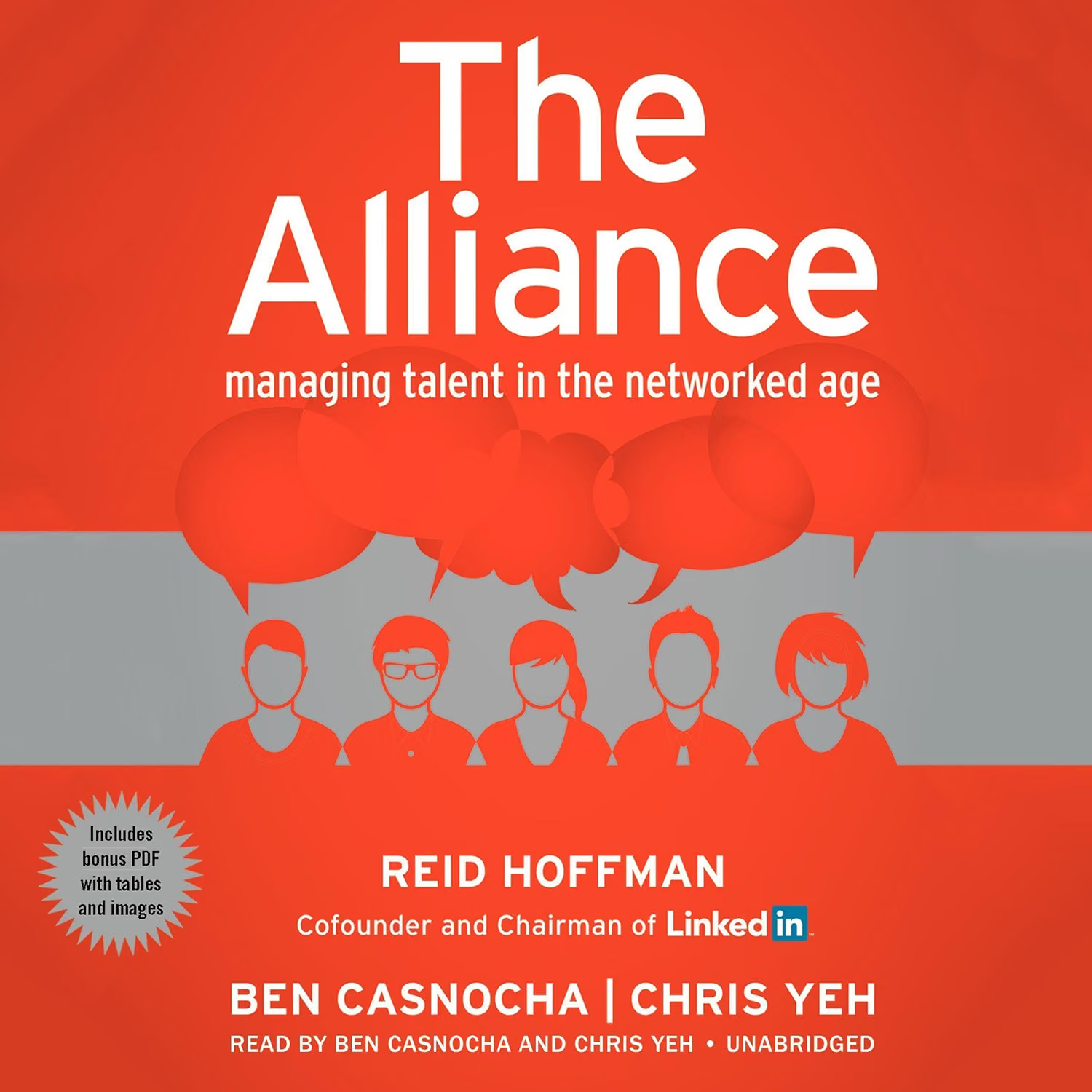
Image by Amazon.de
Of the four books, The Alliance by Reid Hoffman, Ben Casnocha and Chris Yeh probably comes closest to how I think about the relationship between a company and the people who work for it. The authors reject two extremes. One is the familiar idea that a company is a “family”, with the implication that the relationship is somehow permanent and loyalty should be unconditional. The other treats employment as little more than a transaction between independent individuals who happen to need something from each other for a while.
The alternative they describe is an alliance. Employer and employee make a commitment because, for a period of time, their interests overlapped. Both sides should be clear about what they want to achieve together, what they expect from each other and what each should gain from the relationship. I find that much more realistic than pretending a company can promise permanence. Organizations restructure, priorities change, roles disappear and people develop ambitions that may eventually lead them somewhere else.
One of the concepts in The Alliance is the “tour of duty”: a defined mission in which the employee creates something valuable for the organisation while developing their own capabilities, experience and network. That idea changed the way I think about career conversations. Of course I need to ask what the business needs someone to achieve, but I also want to understand what that person should be better at after spending the next year or two on my team. If all I can offer is more of exactly the same work while expecting increasing loyalty in return, that is not much of an alliance.
People give an organisation a meaningful part of their career when they join a team. I cannot promise that a particular role will exist forever or that someone’s ambitions will always align with what the business needs, but I can try to make the time we work together valuable for both sides and be honest when those interests begin to diverge. That also affects how I think about someone eventually leaving. Losing a strong employee can be painful and inconvenient, but keeping someone in a role that no longer helps them grow is not automatically good leadership. If somebody leaves my team more capable, more confident and better prepared for whatever they do next, I can accept that. I would be much more concerned if someone spent several years working for me without developing at all.
Monkey Management: Helping is not the same as taking ownership
Image by Amazon.de
Monkey Management by Jan Roy Edlund probably has the least sophisticated title of the four, but the idea behind it is immediately recognisable if you have managed people for any length of time. The “monkey” is a problem, task or responsibility that belongs to someone else but somehow ends up sitting on the manager’s desk. Someone comes to you with a problem, you talk it through, and at some point you say something like, “Let me look into that.” The conversation ends, the other person walks away, and without anyone explicitly deciding it, the problem is now yours.
Edlund describes this as reverse delegation, and I think it is particularly easy to fall into when you became a manager after being good at the work your team is now doing. Somebody brings you a problem and you probably know how to solve it. Quite often you can solve it faster than they can, so stepping in feels efficient and helpful. Do that often enough, however, and you start teaching the team that difficult decisions move upwards. The manager becomes the fastest route to an answer, while the people bringing the problems gradually lose opportunities to build their own judgement. Eventually the manager is overloaded and the team has become more dependent, even though nobody intended to create that situation.
I have found it useful to become much more deliberate about the point where helping turns into taking ownership. Sometimes the better response is to ask what the person thinks should happen, which options they have already considered, or what they need from me to make the decision themselves. That does not mean responding to every problem with “figure it out yourself.” People sometimes need context they otherwise do not have, help working through a complicated situation, permission to act or simply another perspective. The question is whether I am helping them move the problem forward or quietly making myself responsible for it.
This goes beyond protecting a manager’s calendar. If I prescribe every step, review every detail and reserve every meaningful decision for myself, I should not be surprised when people stop behaving like owners. I have created a system in which ownership sits with me. Good delegation therefore means giving someone enough responsibility to develop their own judgement while still being available when they genuinely need help. In practice, that is harder than simply handing out tasks, but it produces a much more capable team.
The First 90 Days: What worked before may not work now
Image by Amazon.de
Michael Watkins’ The First 90 Days deals with leadership transitions and the need to adapt when moving into a new role. Watkins argues that leaders need to learn quickly, understand the situation they are entering, align expectations, build the right relationships and find appropriate early wins instead of simply bringing the same playbook that worked somewhere else.
I like this book because it addresses one of the less obvious risks that comes with experience: your previous approach probably worked. Over time you develop habits, ways of making desicions and methods for dealing with people because they produced results. It is perfectly reasonable to trust those patterns, right up until the context changes. A different company, a larger team, another culture, a new level of responsibility or a business in a very different situation can make a previously useful instinct much less useful. Experience helps, but only if you are willing to question which parts of that experience still apply.
Watkins makes this situational aspect of leadership concrete through his STARS framework, which distinguishes between startup, turnaround, accelerated growth, realignment and sustaining success. I find the underlying idea more useful than memorising the categories themselves. A leader should first understand what kind of situation they are actually dealing with before deciding how to lead it. A successful team that suddenly needs to scale has different needs from a team struggling with execution. A mature group of experienced people may need much less intervention than a newly assembled one. The leadership rhythm that works in a stable environment may stop working when the market, organisation or strategy changes.
The book also made me think differently about the pressure to prove yourself quickly in a new leadership role. There is a strong temptation to arrive with answers, make visible decisions and demonstrate why you were chosen for the job. Sometimes the more useful work is less visible: listening, understanding how decisions are really made, learning what the team already does well and identifying where the actual problems are before trying to fix them. Moving quickly is useful only if you are moving in the right direction.
These four books approach leadership from very different angles, but I keep coming back to the same connection between them. The leader creates the environment without needing to be at the centre of every decision. People need enough trust to speak openly and enough responsibility to own what happens next. The relationship between employee and organisation should be valuable to both sides without pretending it will necessarily last forever, and the way you lead has to change when the people or circumstances change.
I have become less interested in leadership as the ability to have the right answer and more interested in whether the people around me are becoming better at finding their own. If everything important still needs to come through me, I may be busy, but I am probably not building a particularly strong team. The better outcome is a group of people who know when they can decide for themselves, who are comfortable challenging me when they disagree, and who continue to grow even if that growth eventually takes them somewhere else. If that happens, I am comfortable with the fact that good leadership can sometimes make the leader less necessary.