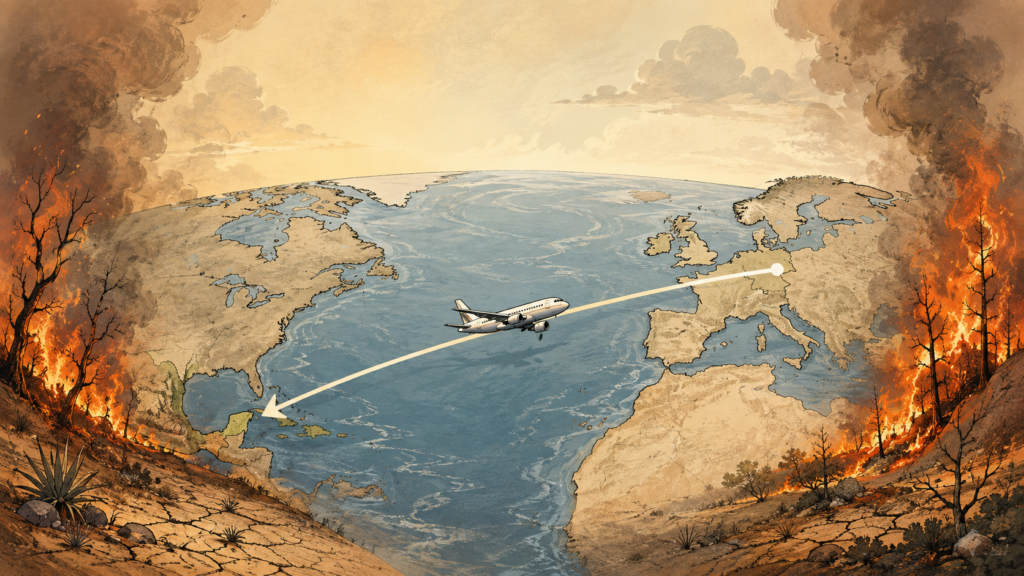

Next week, the three of us will board a plane and travel to Mexico for two weeks. We are excited about the trip. We will spend time together, discover a country none of us has visited before and, if everything goes according to plan, dive in some of Mexico’s cenotes.
We will also cause a considerable amount of greenhouse gas emissions getting there and back.
That is uncomfortable to write because I care about climate change and environmental protection. I argue for renewable energy, lower emissions and political decisions that take the climate crisis seriously. At the same time, I am choosing to take my family on a long-haul flight for a holiday. There is an obvious contradiction here, and pretending otherwise would be dishonest.
I could try to soften it. We do not fly to Mexico every year. We are staying for two weeks rather than going away for a long weekend. There is no realistic train connection across the Atlantic. But none of that changes the basic fact: this is a voluntary journey, and flying is the only practical way for us to make it.
That does not make the flight unavoidable. It means that if we want this particular experience, we have to accept the emissions that come with it.
Compensation is not an eraser
I will calculate the climate impact of our flights and make a corresponding contribution through a provider such as Atmosfair. But I do not want to call the journey climate-neutral.
The carbon dioxide released by the aircraft remains in the atmosphere regardless of what I pay afterwards. Aviation also affects the climate through effects beyond CO₂, including nitrogen oxides, water vapour and the formation of contrails and cirrus clouds. These effects make the climate impact of flying more complicated than the amount of CO₂ produced by burning fuel alone. The IPCC discusses these additional effects in its assessment of transport emissions.
Compensation works differently. A provider calculates the emissions associated with an activity and uses the payment to support projects intended to avoid or reduce emissions elsewhere. That can be useful, but its value depends on the quality of the calculation, the project and the certificates involved. The German Environment Agency recommends examining criteria such as additionality, permanence, the prevention of double counting and independent verification. Its guide to voluntary carbon offsetting explains these limitations and quality requirements in detail.
I therefore see compensation as something worth doing for emissions I have decided to cause, not as permission to ignore them. It is an attempt to reduce the overall impact, not a way to erase the flight or absolve myself of responsibility.
An imperfect decision in an imperfect world
The easiest response to contradictions like this is to demand complete consistency. If you care about the climate, do not fly. If you fly, stop talking about emissions.
That sounds logical, but it sets a standard almost nobody can meet. Living in a modern society means participating in systems that cause emissions. We heat our homes, buy products, use digital services, eat transported food and travel. Some choices have a much greater impact than others, and a long-haul flight is certainly not a minor detail. But a life without any environmental impact is not currently available to us.
That does not mean every choice is equally defensible. “Nobody is perfect” can easily become a convenient excuse for changing nothing. I cannot point to factories, governments or other travellers and conclude that my own decisions no longer matter. They do matter, including the decision to take this flight.
As a family, we try to reduce our footprint in other parts of our lives. We generate electricity with solar panels on our roof and use solar energy to heat our water. We drive an electric car, eat less meat and think more carefully about what we buy, particularly when products have been shipped halfway around the world merely for convenience.
These choices do not cancel our flights. I do not want to present them as entries in a personal carbon account where enough good decisions purchase the right to make a damaging one. They simply show that the Mexico trip is not the only occasion on which we consider our impact. We invest money and effort in reducing the emissions associated with our everyday lives, even when the more climate-friendly option is not the easiest or cheapest one.
At the same time, we are not willing to give up travelling the world altogether. Experiencing other countries, landscapes and cultures together matters to us. It matters even more because we can share those experiences with our daughter and allow her to encounter places beyond those she knows from home, school or a screen.
That is something we value and have consciously decided to preserve, even though it comes at an environmental cost.
Our compromise is to travel deliberately rather than casually. We question which journeys genuinely matter to us, avoid unnecessary flights where we can and stay long enough for a trip to be meaningful. When a train is a practical alternative, we can take it. When we choose to fly, we contribute to credible climate projects for the emissions associated with that decision.
It is not a perfect solution. It is the line we currently draw.
Personal responsibility and structural change
Climate policy cannot depend on finding people who have lived entirely without contradiction. If that were the entrance requirement for taking part in the debate, almost everyone would be excluded and very little would change.
Personal decisions and structural change are not alternatives. Choosing a train instead of a plane where that is practical can reduce emissions. So can travelling less often, staying longer and questioning whether every journey is necessary. Individual choices also influence demand and can establish lower-emission technologies and behaviours in everyday life.
But personal responsibility has limits. We also need cleaner energy, credible carbon pricing, investment in lower-emission transport and rules that apply beyond the relatively small group of people willing and able to make voluntary sacrifices.
Reducing climate policy to individual purity is tempting because it gives us visible people to judge. It is much easier to point at someone boarding a plane than to discuss energy systems, industrial emissions, infrastructure and political decisions. Yet individual inconsistency does not make the need for structural change disappear.
Less judgement, more honesty
When someone who supports climate action flies on holiday, the first reaction is often an accusation of hypocrisy. Sometimes that criticism is justified. Publicly demanding sacrifices from others while quietly claiming exemptions for oneself deserves scrutiny.
But the accusation can also become a way to avoid the more difficult conversation. A person can make a climate-damaging choice and still be right that society needs to reduce emissions. Taking this flight does not invalidate my arguments for renewable energy or better climate policy. Supporting those policies does not make the flight harmless either.
Both things can be true at the same time.
I would rather be open about that tension than construct a story in which our holiday somehow has no consequences. We are choosing to fly to Mexico because this journey matters to us as a family. We will compensate its calculated climate impact through a carefully selected provider because doing something is better than doing nothing. We will not pretend that this makes the emissions disappear.
Perhaps this is the most honest position available to us: making deliberate choices, reducing our impact where we reasonably can and acknowledging the consequences where we cannot. The solar panels on our roof, our electric car, eating less meat and a compensation payment do not make this flight harmless.
Our flight is not good for the climate. It is still a journey we have consciously chosen to make because experiencing the world together as a family, and giving our daughter those experiences, is something we value and are not willing to abandon entirely.